
Learning it Backwards
Update on Retrieving the Dumbbell

At our dog lessons, Tally and I have been continuing our work on the obedience exercise “Retrieving on Flat.” (See “It’s a Process.”) This exercise asks the dog to retrieve a thrown dumbbell and return it to the handler.
(Sorry for the quality of the video. We found that Tally was a bit distracted by having Ray, the cameraman, in the yard. So Ray filmed us through the kitchen window. Next time we’ll remember to remove the screen!)
I am so proud of Tally!! This video represents over one year of work. Yay Tally!!!
Okay—I know what some of you may be thinking. What’s the big deal? This exercise doesn’t seem too complicated. I throw a dumbbell; Tally runs to pick it up and then brings it back to me. Seems simple enough. Lots of dogs play fetch with balls, sticks, and frisbees. Tally does too. If I throw a ball, she will run, pick it up, and run around the yard with it. She can even catch a ball in midair!
However, picking up a dumbbell on command is a whole different story. And it isn’t just learning to wait until she is given the command to retrieve it and bring it directly back to me.
Elise, our trainer, assured me that retrieving a dumbbell is a complex skill that needs to be taught. Most dogs will not intuitively run out and grab a tossed dumbbell. And many dogs, like Tally, won’t intuitively take a dumbbell in their mouths.
If we broke this video into a series of frames, each segment contains a complex set of skills. With Elise’s guidance, we’ve been working on:
Waiting by my side until I toss the dumbbell & give the command to take it.
Picking the dumbbell up in her mouth and carrying it back to me.
Sitting in front of me and waiting for me to take the dumbbell from her mouth
When we started working on learning how to retrieve the dumbbell, I assumed we would break the process into discrete steps, and work through the steps in the order we would do them. This made sense to me.
However, Elise explained that rather than working from the beginning to the end of the exercise we would use the concept of back chaining. Tally and I would learn the exercise by working backwards. We would begin learning the skills for the end of the exercise and then work on the skills leading to the beginning of the exercise.
And although it made sense to break the exercise into discrete pieces to work on, learning them in the reverse order we would perform them in the obedience ring was not intuitive to me.
As a writer and a writing teacher the final product is always something that I work towards. As a teacher I broke the writing of an essay into discrete steps that enabled the students to work towards developing what their final essay would look like. Even though I didn’t know what their actual content would be, I knew the shape the essays would take. During the drafting process I would have the students work on developing their ideas, developing their thesis statements and main points, shaping their body paragraphs, developing a conclusion and introduction.
When I’m working on my own writing projects (my novels and these blog posts) although I’m working towards a final product, I’m never sure what the final product will actually look like. I know that some writers do know the endings of their novels, and write towards that, but that has never been my process. When I start out writing I never know the ending. In fact, most of the time I’m writing to figure out what the ending will be. The end product remains a mystery to me until I get there.
Although I knew what the end product with Tally would look like, how we would get there though back chaining was a mystery. The whole concept of learning the exercise backwards seemed counter-intuitive. However, as we began the training process it made sense. The most difficult part of the exercise was the ending—Tally sitting in front of me holding the dumbbell in her mouth. Once she could hold the dumbbell, the second most difficult part of the exercise was her moving with it in her mouth.
It took about one year to get Tally to take and hold the dumbbell in her mouth. Since Tally likes sticks I started asking her to take a stick and hold it. Then we moved through a range of other objects working our way up to an actual dumbbell.
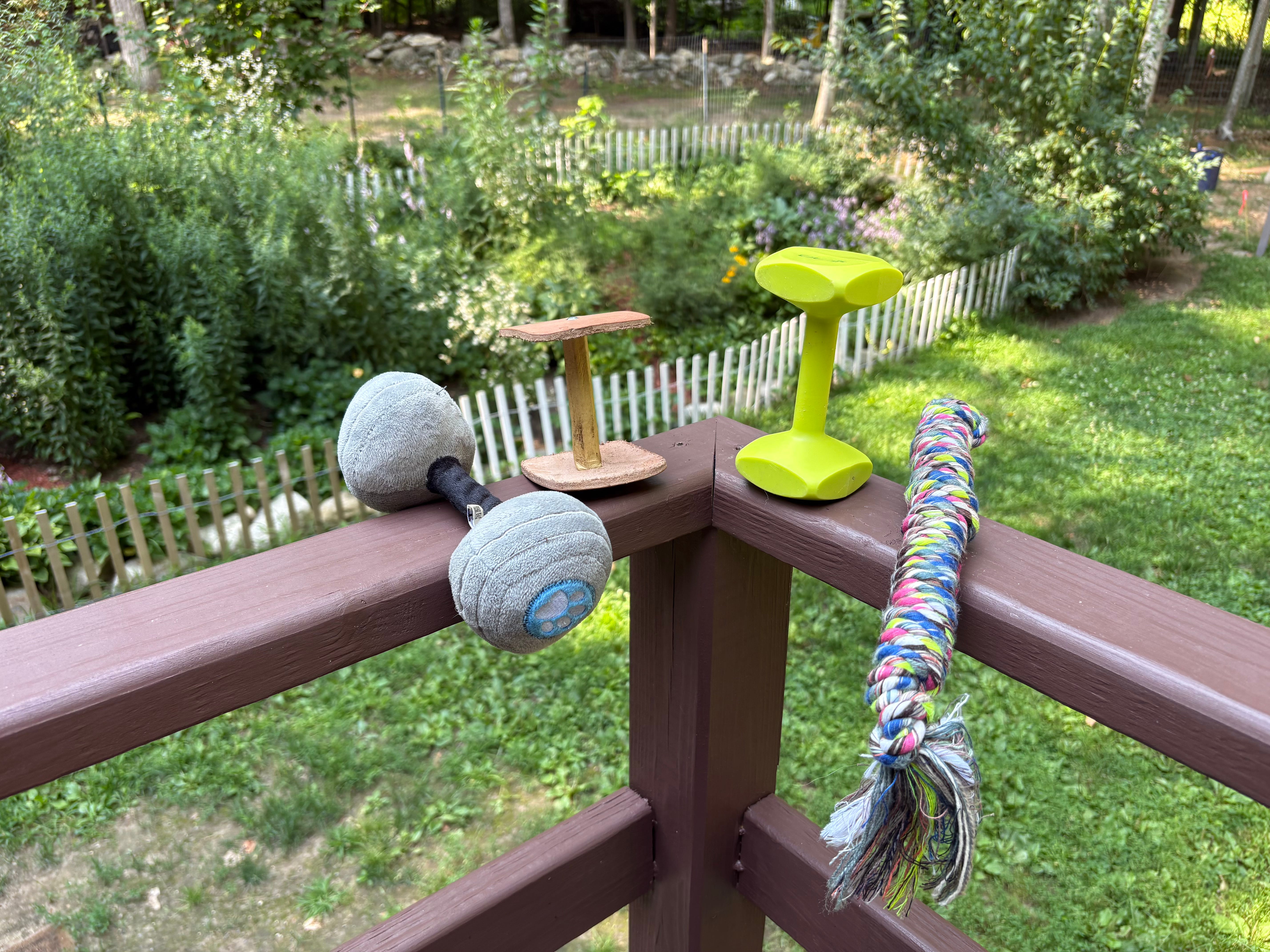
Once she mastered holding the dumbbell in her mouth, we moved to working on the middle part of the exercise—Tally picking up the dumbbell and moving with it in her mouth. Things went quicker. Using our range of objects Tally learned to pick up the dumbbell from the floor in front of me.
She learned how to carry the various objects back to me.
I began to realize this wasn’t just about working backwards. It was about meeting Tally where she was. Sitting by my side and waiting for a command is something Tally already knew how to do. The beginning of the exercise was the easiest part for us. The most difficult part was the dumbbell. Before we could do any other part of the exercise, Tally had to learn everything she needed to do with the dumbbell. Once she mastered those skills, she was able to learn the other aspects of the exercise.
Although this seems so different from my writing and teaching process, it really isn’t. Each teaching situation calls for a starting point that builds on the skills the students already know and do well.
Every writing project I take on also calls for a different process. Although it may seem intuitive to write from the beginning to the end, this has never been my process. I work my way through my novels by writing what seems the most interesting scenes or chapters at the time. In the revision process things get moved around and re-arranged. Rarely is the first chapter I write the first chapter of the final version.
This is like my work with Tally. Back chaining may not seem the most intuitive way to learn “Retrieve on the Flat,” but it works! I am realizing that the order isn’t important—whether we are working forward, backwards, or starting in the middle. The important thing is to meet Tally where she is.
I love this, Peg! The patience required. One year!! Wow! Very instructive to your readers, dog owners or not. I love watching you and Tally. She is such a good girl!
I had no idea that this back to front approach was ever used in dog training— but you have convinced me! And you have demonstrated that Tally has been incredibly successful at working with the dumbbell. Congratulations— you’ve spent a long time working on this trick and the two of you have mastered it!